Thursday, 26 April 2012

Cruelty To Hawksbill Turtles


Daily Express
Thursday, 26 April 2012

KOTA BELUD: If you were angered by the thought of sharks being caught for their fins and then thrown back into the sea where they ultimately die, read on. There's even more to human cruelty.
Three protected hawksbill turtles (Eretmochelys Imbricata) - the majestic creatures you get to see in tourism promotion commercials - were left to die in the waters off the Mantanani islands after their shells were forcibly removed and their eyes punctured to blind them.
The gruesome discovery of the turtles, which can grow up to a metre long and weigh around 80 kilogrammes, was made by staff of a tour operator here on April 20.
Lionel Aaron Lingam, a marine conservation officer with Mari Mari Mantanani Travel and Tour, said this was the first time he had seen something like this at the islands since he started working there.
According to him, their boatman saw a turtle floating towards the dive lodge's jetty around 10.50am and that was when he asked one of his crew members to guide it closer for them to have a look.
"We were all in disbelief as the poor thing which was a female was already very weak after having its shell removed and eyes poked."
"Sadly, the white coloured turtle was dead after 20 minutes," he said, adding that they buried the turtle at Mantanani Kecil.
Another turtle was discovered at about 5pm the same day, floating between Mantanani Besar and Mantanani Kecil.
"The second turtle was smaller and we couldn't identify whether it was male or female," he added.
The third one was spotted in a similar state - minus its shell and eyes blinded - near a jetty at Mantanani Besar.
Lingam said the locals told him that people from the island resort to such cruelty to make souvenirs.
"Unfortunately, we have no evidence to pin-point exactly who had done these cruel acts."
It was learnt that representatives from the Worldwide Fund for Nature (WWF) will be heading here to conduct a post mortem soon while representatives from the Sabah Wildlife Department are being expected on April 26.
The World Conservation Union has classified hawksbill turtles as critically endangered and they are protected under CITES (Convention on International Trade in Endangered Species of Wild Fauna and Flora).
It is among the four marine turtles that can be found in Malaysia and the largest population of hawksbills is found in the Turtle Islands of Sabah with an average of 500-600 nests each season.
Other nesting places are in Malaysia are at Malacca, Johore and Terengganu.
They are primarily found in tropical coral reefs and are usually seen resting in caves and ledges in and around these reefs throughout the day.
As a highly migratory species, they inhabit a wide range of habitats, from the open ocean to lagoons and even mangrove swamps in estuaries.
Like other marine turtles, hawksbills are threatened by the loss of nesting and feeding habitats, excessive egg-collection, fishery related mortality, pollution and coastal development.

Tuesday, 24 April 2012

3 Dead Turtles With Shells Cut Off Found On Island


New Straits Times
Wednesday, Apr 25, 2012
KOTA KINABALU - THREE dead turtles with their shells removed were found on the shores of Pulau Mantanani Kecil in Kota Belud recently.
The hawksbill turtles were found by employees of a backpackers' lodge on the island between Sunday and Monday. An employee said that apart from the shells, which appeared to have been uniformly cut, the eyes of the turtles were also poked.
The shell of hawksbill turtles, known as tortoiseshell, is used to make combs, guitar picks, knitting needles and ornaments.
Since 1973, the trade of tortoiseshell worldwide was banned under the Convention on International Trade in Endangered Species.
Tortoiseshell is preferred because of its durability.
State Wildlife and National Parks Department director Dr Laurentius Ambu said officers would go to the island to investigate the incident.
"Hawksbill turtles are protected reptiles in the state." The shells could have been cut by poachers, said Ambu.
In 1996, Malaysia and the Philippines had set up an area to protect turtles in Sulu Sea. The Turtle Islands Heritage Protected Area covers three islands in Malaysia and six in the Philippines.

Monday, 9 April 2012

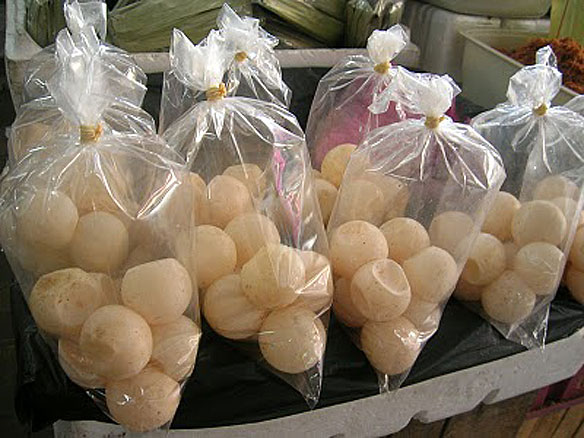
WWF Malaysia Urges Govt To Ban Eating of Turtle Eggs


KUALA TERENGGANU: The World Wildlife Fund (WWF) Malaysia has urged the government to amend the Fisheries Act 1985 to ban the eating of turtle eggs.
WWF Terengganu Turtle Conservation Programme head Rahayu Zulkifli said the sale of turtle eggs openly shows lack of public awareness although many are  aware that turtles are threatened with extinction.
“WWF fears that slow government action in banning eating of turtle eggs will cause extinction as landing of four species of turtles, the leatherback, hawksbill, green and olive ridley, off Terengganu coast has dropped.
“So far, only the leatherback turtle eggs are banned but WWF wants the ban on eating of turtle eggs to cover all species,” she told Bernama here yesterday.
Rahayu said many tourists visit Terengganu to sample turtle eggs as they can be easily buy them as Sabah and Sarawak had banned the sale and eating of turtle eggs.
The Malaysian government last year signed a Memorandum of Understanding (MoU) on the management and conservation of turtles in the Indian Ocean and Southeast Asia (IOSEA) which seek to protect endangered species but no follow-up was done.
WWF also submitted a memorandum on the importance of baning the sale and  eating of turtle eggs to Prime Minister Datuk Seri Najib Tun Razak last year but no progress was made. — Bernama 

Friday, 6 April 2012

Green turtles in Peril


The Star
Friday, 6 April 2012
KUALA TERENGGANU: The effort to save the green turtles is in peril as at least 11 dead turtles have been washed ashore in the state in the first two months this year.
“We believe the latest turtle deaths were due to them being caught in illegal fishing gear.WWF Malaysia executive director and chief executive officer Datuk Dr Dionysius Sharma said reports from the state Fisheries department as well as from the public showed the carcasses of green turtles washed ashore in the beaches in Marang, Dungun, Kemaman, Kuala Terengganu and Setiu.
“The carcasses discovered had the same conditions and marks consistent of interaction with such gears,” he said in a statement recently. Dr Dionysius said five of the carcasses in Kemaman, which were discovered by a local fisherman, had nylon ropes and rock tied to it. “We believe the turtles had been killed and subsequently sunk to destroy any evidence of the heinous act.
“The placing of illegal nets along the shoreline has also been suspected to attribute to death of many turtles in recent years,” he said. He added that there were also cases where some of the turtles were found with its skulls crushed. Painful sight: The carcasses of green turtles washed ashore on beaches in Kuala Terengganu.


For More Details:http://mesym.com/?p=790