Tuesday, 24 April 2012

3 Dead Turtles With Shells Cut Off Found On Island


New Straits Times
Wednesday, Apr 25, 2012
KOTA KINABALU - THREE dead turtles with their shells removed were found on the shores of Pulau Mantanani Kecil in Kota Belud recently.
The hawksbill turtles were found by employees of a backpackers' lodge on the island between Sunday and Monday. An employee said that apart from the shells, which appeared to have been uniformly cut, the eyes of the turtles were also poked.
The shell of hawksbill turtles, known as tortoiseshell, is used to make combs, guitar picks, knitting needles and ornaments.
Since 1973, the trade of tortoiseshell worldwide was banned under the Convention on International Trade in Endangered Species.
Tortoiseshell is preferred because of its durability.
State Wildlife and National Parks Department director Dr Laurentius Ambu said officers would go to the island to investigate the incident.
"Hawksbill turtles are protected reptiles in the state." The shells could have been cut by poachers, said Ambu.
In 1996, Malaysia and the Philippines had set up an area to protect turtles in Sulu Sea. The Turtle Islands Heritage Protected Area covers three islands in Malaysia and six in the Philippines.

Monday, 9 April 2012

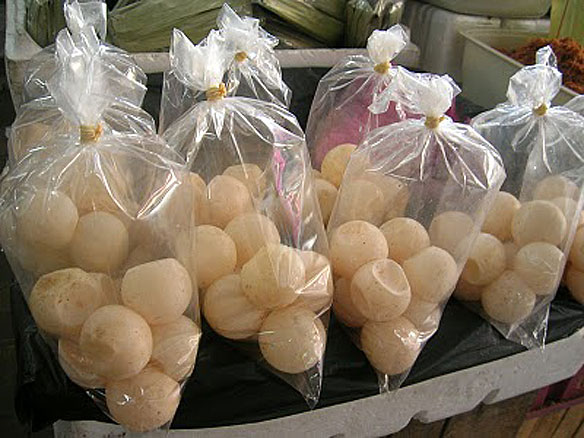
WWF Malaysia Urges Govt To Ban Eating of Turtle Eggs


KUALA TERENGGANU: The World Wildlife Fund (WWF) Malaysia has urged the government to amend the Fisheries Act 1985 to ban the eating of turtle eggs.
WWF Terengganu Turtle Conservation Programme head Rahayu Zulkifli said the sale of turtle eggs openly shows lack of public awareness although many are  aware that turtles are threatened with extinction.
“WWF fears that slow government action in banning eating of turtle eggs will cause extinction as landing of four species of turtles, the leatherback, hawksbill, green and olive ridley, off Terengganu coast has dropped.
“So far, only the leatherback turtle eggs are banned but WWF wants the ban on eating of turtle eggs to cover all species,” she told Bernama here yesterday.
Rahayu said many tourists visit Terengganu to sample turtle eggs as they can be easily buy them as Sabah and Sarawak had banned the sale and eating of turtle eggs.
The Malaysian government last year signed a Memorandum of Understanding (MoU) on the management and conservation of turtles in the Indian Ocean and Southeast Asia (IOSEA) which seek to protect endangered species but no follow-up was done.
WWF also submitted a memorandum on the importance of baning the sale and  eating of turtle eggs to Prime Minister Datuk Seri Najib Tun Razak last year but no progress was made. — Bernama 

Friday, 6 April 2012

Green turtles in Peril


The Star
Friday, 6 April 2012
KUALA TERENGGANU: The effort to save the green turtles is in peril as at least 11 dead turtles have been washed ashore in the state in the first two months this year.
“We believe the latest turtle deaths were due to them being caught in illegal fishing gear.WWF Malaysia executive director and chief executive officer Datuk Dr Dionysius Sharma said reports from the state Fisheries department as well as from the public showed the carcasses of green turtles washed ashore in the beaches in Marang, Dungun, Kemaman, Kuala Terengganu and Setiu.
“The carcasses discovered had the same conditions and marks consistent of interaction with such gears,” he said in a statement recently. Dr Dionysius said five of the carcasses in Kemaman, which were discovered by a local fisherman, had nylon ropes and rock tied to it. “We believe the turtles had been killed and subsequently sunk to destroy any evidence of the heinous act.
“The placing of illegal nets along the shoreline has also been suspected to attribute to death of many turtles in recent years,” he said. He added that there were also cases where some of the turtles were found with its skulls crushed. Painful sight: The carcasses of green turtles washed ashore on beaches in Kuala Terengganu.


For More Details:http://mesym.com/?p=790 

Tuesday, 20 March 2012

Saving Turtles

New Straits Times
March 20, 2012


IF, as some mythologies would have it, the world really is held up by giant turtles, then, by the speed with which turtles are disappearing, this world is in big trouble. Of the 30 turtlespecies discovered, 23 no longer exist. Of the remaining seven, six are listed as "critically endangered" and "endangered" in the International Union for Conservation of Nature Red List of Threatened Species. Hundreds of thousands of turtles are caught in trawl nets and gill nets each year and drown because they were unable to surface for air.

Beyond mythology, turtles play a vital role in keeping ocean ecosystems in balance. For instance, Hawksbill turtles maintain the marine sponge balance in the ocean, and this allows coral reefs to grow. Leatherback turtles, which feed on jellyfish and have been known to eat up to 200kg of jellyfish a day, keep the jellyfish population in check. Too much jellyfish can adversely affect fish stocks, since they feed on fish eggs and larvae.

Yet, though so vital to the environment, turtles face many hurdles in their quest for survival. Even though a female turtle can lay hundreds of eggs, only one in 1,000 hatchlings will make it to adulthood. Turtle eggs have many predators, among whom are humans. Hatchlings that live take decades to mature. If they survive to that stage, death can come in the form of discarded plastic bags (that they mistake as jellyfish, and eat), trawl nets and poachers. And when mature and ready to set up family, turtles are deterred from mating or laying eggs if their beach is disturbed in the slightest. Bright lights, noise, human activity, or any coastal development, will drive them away.

In Malaysia, turtles play another important role - as an eco-tourism attraction. Tourists flock to turtle beaches like Cherating, Pulau Tioman and Pulau Perhentian, and pay a lot of money to see the turtles. The small village of Rantau Abang in Terengganu exists in the national consciousness solely because it was once home to the leatherback turtle. Though recent landings have given the village a spark of hope, a severe drop in turtle sightings and returns over the last 30 years drove the government to declare the leatherback locally extinct, virtually killing the tourism industry there. To revive its turtle populations, Malaysia must institute a total ban on the sale and consumption of turtle eggs, remove turtles from the jurisdiction of the Fisheries Act 1985 and place them under the protection of the stringent Wildlife Conservation Act 2010.


Hatchery Releases Baby Turtles

News Straits Times
March 20, 2012


PORT DICKSON: About 1,300 baby hawksbill turtles, hatched at the Glory Beach Resort Turtle Hatchery, were released into the sea between June and December last year.

This is more than 70 per cent of the total number of eggs collected by the hatchery from residents in the area and the Malacca Fisheries Department.

Chief of the Rantau Abang Turtle Centre and Marine Ecosystem Syed Abdullah Syed Abdul Kadir said the successful programme was initiated in September 2010 to rescue as many turtle eggs as possible in the area.

"We asked members of the public who find turtle eggs to send it to the hatchery where they will be incubated.

"After hatching, the baby turtles are released into the sea.

"We hope they will return to the area here someday as adults to lay their eggs," he said.

He was speaking at a recent awareness programme for the media at the hatchery.

The turtle rehabilitation programme is a joint effort between the Turtle Centre, Malacca, Negri Sembilan Fisheries Departments, and Glory Beach Resort.

Also present were state executive councillor for tourism Datuk Mohammad Razi Kail, Port Dickson municipal council president, Abdul Wahab Shamsuddin and Glory Beach Resort general manager Isaac Raj.

Syed Abdullah said the main objective of the programme was to create awareness of turtle conservation - and the importance of safeguarding the turtles and their habitat - among the locals, tourists and fishermen.

He said they expect to incubate. hatch 3,000 eggs this year